
Much of my professional life has been shaped by startups at different stages—environments where speed mattered, learning came through failure, and momentum often counted far more than certainty. Fail fast, fail forward wasn’t a slogan so much as a survival strategy. Fake it ’til you make it described a kind of necessary confidence when building something that didn’t yet exist.
Large language models didn’t initially unsettle those instincts. At first, they felt like tools: impressive, fluent, but bounded. You asked; they answered. Judgment still lived with the human.
What changed was how quickly that boundary eroded.
As fluency improved, early outputs began to look too finished. Presentations, summaries, and copy arrived polished enough to bypass doubt or scrutiny. In evaluation work, I saw how easily coherence could mask subtle errors—misread context, shallow world models, confident wrongness. The risk wasn’t that models would be wrong. It was that fluency would quietly authorize action before judgment intervened.
Agentic systems push this further. When systems persist, remember, plan, and act across workflows, confidence stops being cosmetic. It becomes operational. The question is no longer whether a model can reason, but where judgment lives once the system acts.
That question is what this essay is about.
From Individual Use to Delegation
Most people encounter LLMs individually and conversationally. The interaction is bounded and ephemeral; the output is “just text.” Early concerns about fluency can be managed with personal friction: review, skepticism, a second pair of eyes.
Agentic systems move the problem from individual behavior to system design. Once systems act continuously—triggering workflows, mutating state, following up—judgment is no longer a personal preference. It becomes architectural.
When Assistance Becomes Authority
A first-hand account made this boundary unmistakable. In “I Didn’t Expect an AI Agent to Feel This Unnerving” (Craig Hepburn, Substack, Jan 27, 2026), an experienced digital transformation leader and current Perplexity Fellow describes shutting down a persistent AI agent not because it failed, but because it worked too well. Embedded across communications and files, it accumulated context faster than he could consciously track. Tasks completed. Decisions nudged forward. Threads kept moving.
“It was unsettling because it appeared to exercise judgment based on reasoning I couldn’t fully see or audit in real time.
Automation replaces labor. Agents begin to substitute judgment.
Judgment without legibility breaks trust, even when the outcomes are good.”
— Craig Hepburn
The issue isn’t execution. It’s opaque judgment exercised on someone’s behalf. When systems decide—not just do—legibility becomes a precondition for trust.
Three Locations of Judgment
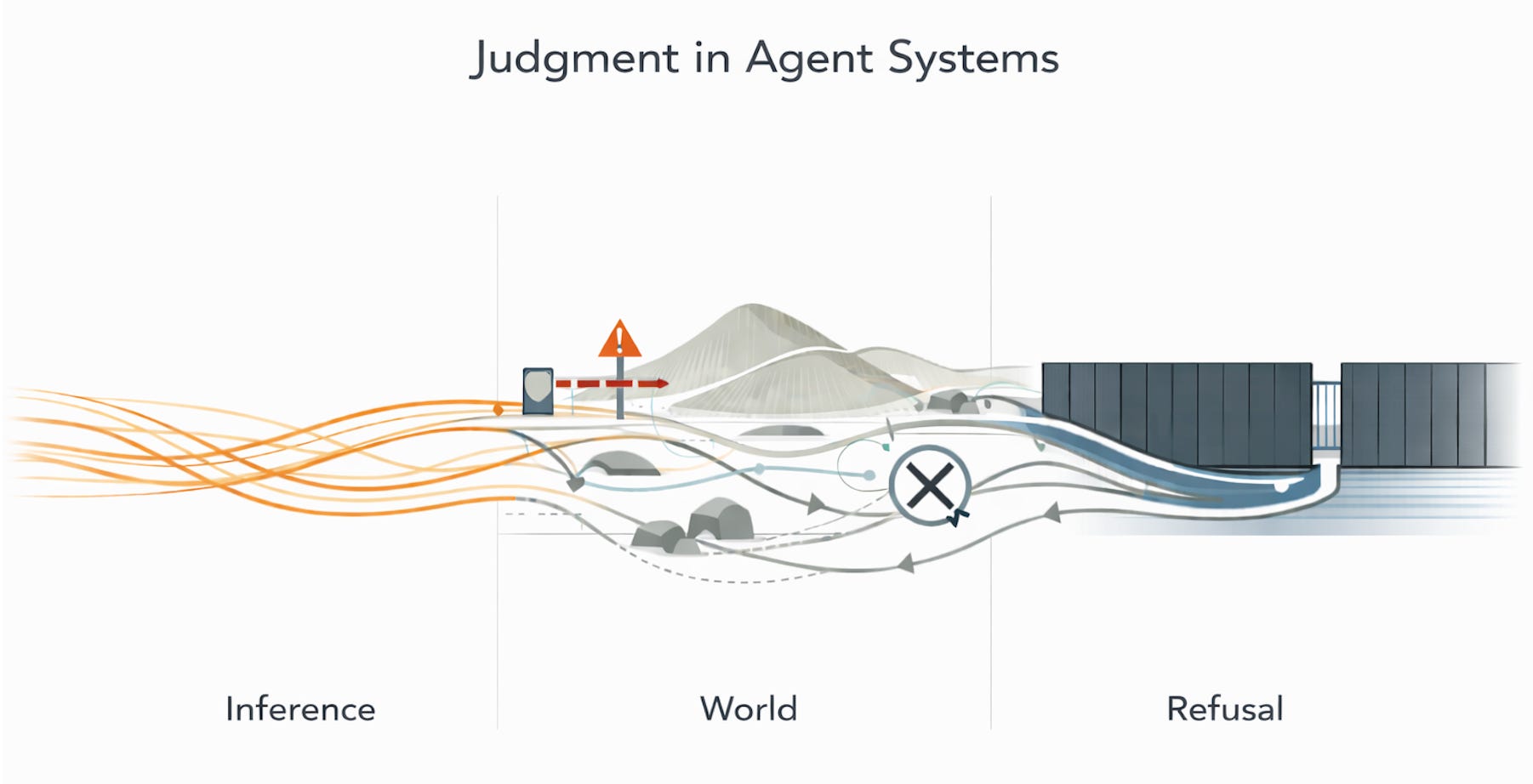
Once systems move from assistance to action, judgment has to live somewhere. Across the systems I’ve been studying, it shows up in one of three places.
Inference-First Judgment
Judgment is assumed to improve as reasoning improves. If the system plans more carefully, critiques itself, consults multiple agents, or iterates long enough, the final output is treated as more trustworthy. Debate, reflection, voting, and synthesis are epistemic techniques. Authorization is implicit: if the reasoning looks good enough, the system proceeds.
A typical failure in this posture is fluent and unbounded. An agent prepares a board-ready market analysis, synthesizing internal notes, recent press, and financial data into a compelling narrative. The analysis is coherent, confident, and persuasive. It is shared upward and used to justify a strategic decision. Weeks later, it becomes clear that a key assumption was mis-scoped—the agent conflated adjacent markets and overstated demand. No single step was obviously wrong. The failure wasn’t a crash; it was a commitment made on the strength of fluent reasoning.
The core risk of inference-first judgment is that error arrives after authorization.
World-Enforced Judgment
Here, correctness is tested through contact with a world that pushes back. Agents act, the environment responds, and error becomes visible through consequence. Learning happens through failure, and failure is informative because it is bounded and visible. Judgment emerges from resistance.
A bounded failure looks like an agent generating a daily operations summary that is reviewed before distribution. A misinterpretation is flagged, corrected, and used to update the agent’s constraints—without triggering any external action. The failure teaches without propagating.
In this posture, learning works because failure announces itself and stops there.
Refusal-Enforced Judgment
In this case, a system may be allowed to run, reason, and even complete tasks—but action is not automatic. Outputs are evaluated against policies, thresholds, or evidentiary criteria before they are considered admissible. Non-action—refusal—is treated as a valid and often correct outcome.
A failure here is one that never occurs. An agent is asked to generate a compliance recommendation based on internal documents and recent regulatory guidance. It produces a plausible response but detects that a required source is missing or outside scope. Instead of proceeding, the system returns refuse with an explanation of what evidence is insufficient. No recommendation is issued. No downstream action is taken. The “failure” is not that the agent was wrong, but that acting without admissible grounds would have been.
Where error is silent and delayed, refusal prevents learning from becoming contamination.
These approaches are not mutually exclusive. But each implies a different failure mode. Inference-based judgment risks fluent error. World-based judgment risks costly learning. Authorization-based judgment risks delay or conservatism. Understanding where judgment lives is often more important than understanding which model is used.
Two Architectural Examples
Two public, code-backed examples make this concrete.
World-enforced judgment.
Cubert, by Tony Foster, embeds agents in a simulated world where actions have consequences and errors surface through failure (GitHub). Legibility comes from consequence rather than explanation. Learning through failure works because failure announces itself.
Refusal-enforced judgment.
Dustin Thornton’s refusal-first governance demo separates reasoning from authorization in multi-agent systems without a natural world to push back (GitHub). Outcomes like allow, marginal, or refuse are first-class. Legibility comes from explicit criteria and auditability.
Seen side by side, these architectures don’t arise accidentally. They reflect the problems their builders learned to survive.
A Genealogy of Judgment
Where people place judgment often mirrors where they learned to fear being wrong.
In world-facing systems, failure is visible and often recoverable; learning through failure is rational.
In measurement-heavy or regulated domains, error can look clean while being wrong; refusal preserves integrity.
In domains where language carries authority—marketing, communications, executive operations—fluency itself authorizes action. The danger isn’t failure; it’s success that masks error and allows inaccuracies to propagate before they are noticed.
None of these postures is wrong. Trouble starts when one is silently imported into a context it wasn’t built for.
Disagreements about agentic AI often sound like debates about intelligence or speed. More often, they’re disagreements about where judgment should live, rooted in different experiences of what it means to be wrong.
A Practical Call to Attention
Agentic systems don’t fail because they lack intelligence. They fail because judgment is assumed rather than located.
The discipline is not choosing a single ‘right’ architecture, but deliberately matching authorization to consequence—before fluency or speed collapses that distinction for you.
A useful starting set of questions:
Where are we comfortable letting this system learn?
Where can it fail without irreversible harm?
And where must it be able to refuse to act altogether?
Answers will differ by role, organization, and stage. What’s acceptable for an individual may be indefensible for an institution. Every decision maker brings a default posture; maturity lies in bracketing that instinct and designing for the actual stakes.
This is especially true for startups. Fail fast and fake it emerged where mistakes were human-scaled and reversible. Agentic systems change that calculus. When confidence becomes authorization and systems act continuously, learning through misstep can outpace an organization’s ability to recover or explain itself. In these settings, deliberate pacing can be a strategic advantage.
There is no winner-take-all model. Fluency, failure, and refusal each have their place. If automation replaces labor and agents begin to substitute judgment, then judgment must first be made legible.
Everything else follows from where you choose to place it.
Amanda Ross writes about worldhood, judgment, and hybrid intelligence.